
All my life I’ve loved Halloween. I have fond childhood memories of my favorite costumes: the gypsy, draped in soft flowing scarves, wearing earrings long before I was old enough in “real” life; the pirate, with a black patch over one eye, front teeth and chin blackened with charcoal; the Japanese princess, wearing chrysanthemums my mother cut from the backyard and pinned to each side of my head. In my adult life I’ve continued to enjoy Halloween. The pirate remains a favorite costume, but I’ve also added the clown, a Spanish flamenco dancer one year, and more recently, a mime dressed all in black and white except for a red cap.
Even as a child I had a vague sense that there was something deep and mysterious about Halloween. As I grew older, I became progressively haunted by that sense of “something more.” In recent years I’ve come to understand consciously and theologically what I subconsciously intuited as a child.
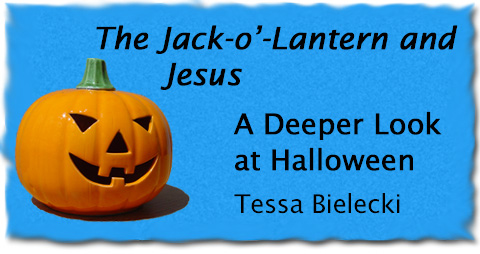
The depth of meaning revolves around the jack-o’-lantern. Whenever I see one, my heart rejoices. Psychologist Carl Jung teaches us to pay careful attention to signs, symbols, and myths that trigger powerful emotions. So I’ve continued to explore why the jack-o’-lantern makes my heart soar. Surely there’s more to it than my love of crisp autumn air, the color orange, and Halloween costumes.
Pagan Roots
The origins of Halloween date back to the
Druidic Celts who lived all over Europe
between 1000 and 100 B.C. until conquered
by Julius Caesar and absorbed by Rome.
The Celtic New Year’s Eve Festival
was called Samhain (literally “summer’s
end” and pronounced “Sah-ween”)
and began at sunset on October 3l, continuing
through the night until dawn on November
l, first day of the Celtic New Year. With
the autumn harvest came the dying of the
year as well as the dying of the land,
the coming of the dark season, and the
cold of winter, under the rule of Samhain,
Lord of the Dead.
Before the Festival of Samhain (also the Celtic name for the winter season), the people stored their summer crops and secured their livestock for the winter, moving cattle, sheep, and horses to closer pastures. They slaughtered surplus cattle for the feast and burned the bones in “bone fires.” The “bonfires” were also kindled in honor of the departed Sun God. Julius Caesar describes more terrifying aspects of the Samhain celebration when the Druids burned wicker cages of men, women, and animals, along with bread, wine, and honey, seeking the gods’ favor by sacrificing their most valuable gifts. Horses were sacrificed, too, until the seventh century when Pope Gregory the Great issued a decree against it, suggesting that the people kill oxen instead for food “to the praise of God, and give thanks to the Giver of all gifts for His bounty.”
Celtic Day of the
Dead
At Samhain, more than any other time of
the year, the Celts believed that the ghosts
of the dead mingled with the living. On
this night, the souls of those who had
died the year before traveled to the underworld.
The bright bonfires served a dual purpose
and expressed both the Celtic people’s
fear and awe of the dead. On the one hand,
the fires honored the dead and aided them
on their journey. Room was made around
the fire for the wandering souls to warm
themselves, and food and drink were laid
out for them as well. In their compassion,
the living Celts sought to comfort the
departed spirits in their pain.
But the Celts also feared the dead. The God Samhain transformed those who had died in sin into animals, and this night he summoned them for judgment. He would decide if they were to remain in animal form for another year or be allowed to enter paradise. On trial and angered by their animal state, the souls of the dead hovered in the air, capable of great mischief and wicked tricks. So the Celts dressed as animals themselves and danced through the night, hoping to lead the ghosts into paradise at dawn. And they kept their bonfires burning to protect themselves from the dead.
All Saints and All
Souls
In the eighth century, Pope Gregory III
moved the feast of All Saints’ Day,
“All Hallows” or “All
the Holy”, from May l3 to November
l. October 31, All Hallows’ Evening,
became All Hallows’ E’en, and
finally Halloween.
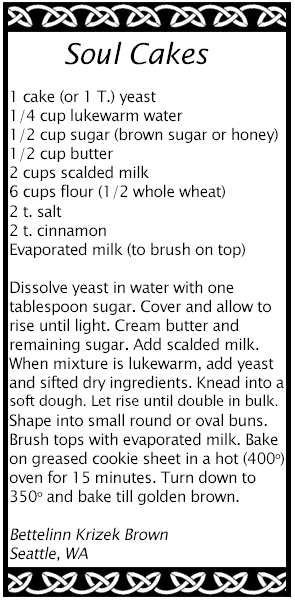
In the nineth century, November 2 became All Souls’ Day, the Christian Day of the Dead, when the living pray for the souls of the departed. In Medieval England, people went “a soulin’” and prayed for the souls of the dead in exchange for a piece of “soul cake.” For years I enjoyed this song at Christmas instead of Halloween and never understood its significance
Soul! Soul! Soul cake;
Please, good mistress, a soul cake,
Apple, pear, plum, or a cherry,
Any good thing to make us all merry;
One for Peter, two for Paul,
Three for Him that made us all.
The ending lines, which I only recently learned, hint at the contemporary custom of “tricking” if not given a “treat”: “Up with your kettle and down with your pan; Give me a good big one, and I’ll be gone.” (Or else!)
Halloween in America
According to the research of Michael Judge,
the Protestant Reformation almost extinguished
the observance of Halloween: “Reformist
churches banned Halloween celebrations
as satanic rituals and claimed that the
Catholic Church, in allowing them to continue
for so long, revealed itself as a heathen
institution.” Halloween became widespread
in America only after the mid-l9th century
arrival of Irish Catholics. These survivors
of the great potato famine of l848 were
a welcome antidote to the Puritans of Colonial
America who equated Halloween with superstition
and black magic.
The American Irish, descendents of the ancient Celts, kept the traditional observances of Halloween and gave us the jack-o’-lantern. In Ireland these Samhain lanterns were carved out of potatoes or turnips and commemorated “Jack,” an Irish rogue so villainous that neither heaven nor hell wanted him, and he was doomed to wander endlessly, looking for a place to rest. It is unclear to me whether “Jack” was the potato or the potato lit his way, welcoming him as the early Celts welcomed lost souls around their bonfires. Some say that the face carved into the vegetable was the face of a loved one who had died in need of prayer. It is definitely clear, however, that the native American pumpkin makes a bigger and far more glorious jack-o’-lantern than a potato or a turnip!
The celebration of Halloween is seriously threatened today by conservative and fundamentalist Christianity. We’re told to avoid commemorating this day because it’s pagan and not Christian; because it’s childish and therefore foolish; because it’s satanic and evil. As Michael Judge laments: “It’s ironic that Halloween, which managed to make it as a genuine pagan remnant through so many centuries in a devoutly Catholic Europe, should be threatened in a society with a constitutional guarantee of religious freedom.” We need to “save” Halloween by embracing the deeper Christian truths it embodies.
Childish or Childlike?
In my fat file folder on Halloween I keep
my favorite quote from Nikos Kazantzakis.
It’s done in exquisite calligraphy
by our friend, Michelle Reineck, of Kalamazoo,
Michigan, who also loves Halloween and
dresses up like a witch to both the dread
and delight of the trick-or-treaters who
come to her door. Michelle topped the quote
with a bright orange pumpkin sticker and
did the lettering in both orange and black,
the traditional Halloween colors. Orange
is the color of the autumn harvest, black
the color of death. The passage from Kazantzakis
reflects the spirit of Halloween as reflected
in the Christian Scriptures:
“Everyone needs a little bit of madness.
Otherwise we’ll never be able to
cut the rope and be free.”
St. Paul echoes the “virtue”
of madness when he tells us to become “fools
for Christ.” In his first letter
to the Corinthians, Paul writes:
“Here we are, fools for the sake of Christ…Make no mistake about it: if any one of you thinks of himself as wise, in the ordinary sense of the word, then he must learn to be a fool before he can be wise. Why? Because the wisdom of this world is foolishness to God….For God’s foolishness is wiser than human wisdom, and God’s weakness is stronger than human strength” (1 Cor. 4:10, 18-19; 1 Cor. 1:25).
In the paradoxical strength of weakness
and the wisdom of foolishness, Jesus called
a little child to him and set the child
in front of his disciples. “Unless
you change and become like little children,”
he said, “you will never enter the
kingdom of heaven. And so, the one who
makes himself as little as this little
child is the greatest in the kingdom of
heaven” (Mt. 18:1-4). Jesus also
exclaimed: “I bless you, Father,
Lord of heaven and of earth, for hiding
these things from the learned and the clever
and revealing them to mere children”
(Mt. 1l:25).
When we celebrate Halloween, then, we are
not childish but childlike in the Gospel
sense; foolish perhaps in the eyes of the
world, but wise in God’s eye; not
puritanical but supremely Catholic, which
also means a bit pagan and Druidic as well.
Overcoming Evil
and Fear
Some people are afraid to celebrate Halloween
because they believe it’s satanic.
A concerned friend sent me the following
passage from a contemporary witch: “Not
only is Halloween one of our grandest feasts,
it is also our biggest laugh on Christians.
While we celebrate a Black Mass, sacrifice
live animals and drink their blood, and
give homage to Satan our glorious king,
Christians all over the world are helping
us by having Halloween parties and dressing
up as devils, goblins and witches. With
them unknowingly supporting our cause for
evil, his power is multiplied.”
To me this seems like empty boasting.
Yes, the devil is real. The power of evil
is real, lurking both “out there”
and inside each of us. We must be aware
of real satanic cults who abuse animals
or children for ritual purposes, especially
on October 31.
Does this mean that Christians should cringe
in fear and not celebrate Halloween? I
think it means we should celebrate the
day even more as the Christians’
“biggest laugh” on Satan and
his cults! When we celebrate Halloween,
we do not support Satan’s “cause
for evil.” We celebrate the power
of the Risen Christ who overcame the devil
and the power of evil, the power of fear
and death.
Our faith assures us of this. Psalm 91 insists that we “not fear the terror of the night…not the pestilence that roams in darkness…No evil shall befall you…For to his angels he has given command about you, that they guard you in all your ways.” And we pray in the much loved 23rd Psalm: “Even though I walk in the valley of darkness I fear no evil; for you are at my side.” “Be not afraid,” we sing at Mass in one of my favorite hymns. “Be not afraid, I go before you, come, follow me.”
Throughout his Good News, Jesus reminds
us again and again that we need not fear,
but nowhere more eloquently than in his
Last Supper discourse:
“Do not let your hearts be troubled.
Trust in God still, and trust in me….Do
not be afraid…. The prince of this
world is on his way. He has no power over
me…. I have told you all this so
that you may find peace in me. In the world
you will have trouble, but be brave: I
have conquered the world” (John 14:1,
27, 30; 16:33).
St. Teresa once said that she was more afraid of people who were afraid of the devil than she was of the devil himself! Me, too. I’m more concerned about people who are afraid of Halloween because of satanic influences that I am of those influences.
When we dress like a red devil on Halloween, we do not empower Satan but mock him as a silly little imp who cringes and whimpers in the presence of Jesus like the Gadarene demoniacs: “What do you want with us, Son of God? Have you come here to torture us…?” (Mt. 9:29). When we dress like ghosts or skeletons, we mock death because we believe that Christ has conquered and reversed death by rising from the tomb, as we, too, shall be raised from the dead. We laugh with St. Paul: “Death is swallowed up in victory. Death, where is your victory? Death, where is your sting?” (1Cor. 15:55).
The Laughter of
Christ
In his tiny book, The Humor of Christ,
Quaker writer Elton Trueblood inspires
us with the proper Christian attitude towards
Halloween, though he did not have Halloween
specifically in mind:
“Any alleged Christianity which
fails to express itself in [joy], at some
point, is clearly spurious. The Christian
is [joyful], not because he is blind to
injustice and suffering, but because he
is convinced that these, in the light of
the divine sovereignty, are never ultimate….Though
he can be sad, and often is perplexed,
he is never really worried. The well-known
humor of the Christian is not a way of
denying the tears, but rather a way of
affirming something which is deeper than
tears.
Far from laughter being incompatible with
anguish, it is often the natural expression
of deep pain….’Terror’,
says Samuel Taylor Coleridge, ‘is
closely connected with the ludicrous; the
latter is the common mode by which the
mind tries to emancipate itself from terror.
The laugh is rendered by nature itself
the language of extremes, even as tears
are.’ It is not possible to have
genuine humor or true wit without an extremely
sound mind, which is always a mind capable
of high seriousness and a sense of the
tragic….Kierkegaard echoed this conclusion
when he said that the comic and the tragic
touch each other at the absolute point
of infinity.”
This spirit of Christian comedy, laughter, and joy makes me celebrate Halloween as an Easter in the autumn! Christ is risen from the dead. As St. John Chrysostom said in his Easter Sermon: “Now hell is a joke, finished, done with.” As we hear in the Easter Exsultet: “Christ has conquered! Glory fills you! Darkness vanishes forever! Rejoice, O Mother Church! Exult in glory! The risen Savior shines upon you!”
According to St. Augustine, “We are an Easter people, and our song is alleluia!” (Note all the exclamation points here.) Tom Renaud describes the same triumph in one of his Easter songs:
“Love is risen from the tomb of
pain
Love is risen from the cross of shame
Love is risen from the dragon’s den
Love can never die again.”
Smiling Jack
I’ve finally come to understand why
I love jack-o’-lanterns so much,
especially the smiling ones. Jack represents
the risen Christ! Jack is Jesus! I’m
haunted by Halloween because it’s
Easter! More lines from Tom’s music
express this mystery:
Now the laughter of the risen Lord,
Comes like the flash of a sword….
Now the singing of a single man,
Can smash the stranglehold of death’s
dark hand….
In the light of morning, his laughter cracked
the sky;
It echoes through the ages, and his reign
will never die.
The jack-o’-lantern proclaims the Resurrection. The jack-o’-lantern glows with light in the darkness because Jesus is the “Morning Star who came back from the dead,” the Light of the world, “the lamp of endless day.” The jack-o’-lantern may well be that villainous Irish rogue or other lost souls wandering in the dark, but Jack-Jesus brings them into the light of his fiery sacred heart where they find rest, as we say in our most popular prayer for the dead: “Eternal rest grant unto them, O Lord, and may perpetual light shine upon them.”
This is the depth we celebrate on Halloween when we dress up in costumes and party or go trick-or-treating, when we light roaring bonfires, when we carve pumpkins, make jack-o’-lanterns and fill them with the light of Christ. So a jack-o’-lantern candle sits on my desk all year round, not only because I love Halloween, but because it has profoundly Christic significance.
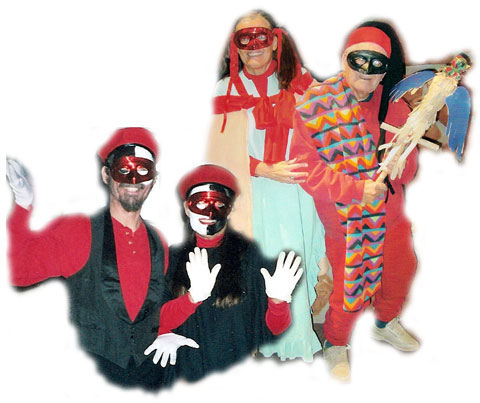
Tessa and Fr. Dave as mimes; Tessa and her ninety-five-year-old father, Cas as medieval lady and court jester.